

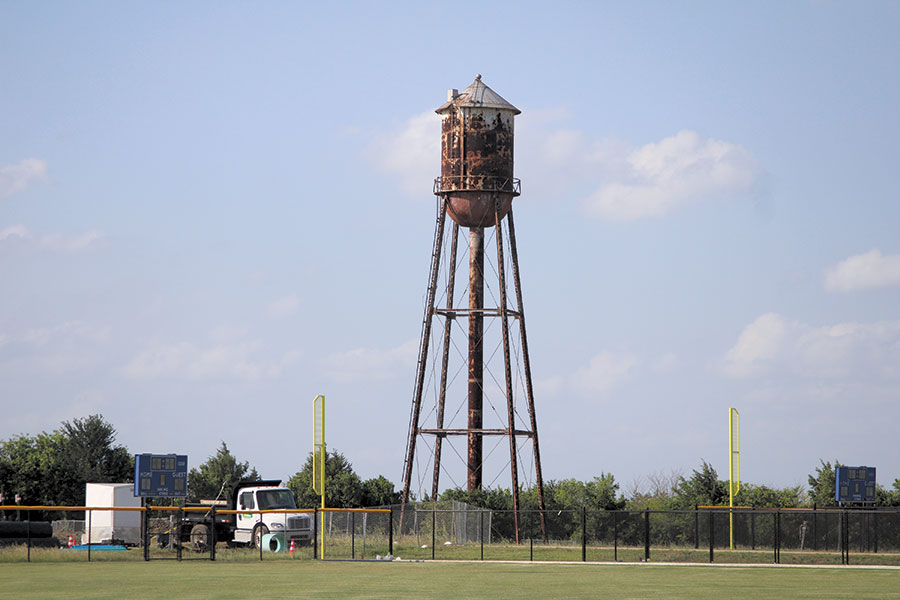
The rusted water tower is one of the last visible reminders of the Princeton POW Camp, which briefly housed German prisoners of war during World War II.
The Stories Collin County Forgot to Notice
Every time I drive through Princeton, I pass the same brown sign.
You probably know the kind. White lettering. An arrow pointing toward something that’s apparently very important. A quick reminder from the State of Texas that history of some sort happened here. Usually, I glance at it and keep driving. Life has a funny way of convincing us that whatever is at the end of the arrow can wait until another day.
A few weeks ago, another day finally arrived.
The sign pointed toward the Princeton POW camp, so I decided to follow it. After a few turns, I arrived at a familiar site: J.M. Caldwell Sr. Community Park. As most people in Princeton know, baseball diamonds and soccer pitches stretch across the property.
When I arrived, parents sat in folding chairs watching youth baseball and soccer games while coaches barked instructions from dugouts. It looked like the type of scene that plays out every weekend in communities across Texas.
Then I remembered why I was there. I started my quest to find the prisoner-of-war camp. The problem was that there wasn’t much to find.
After wandering around the complex for a few minutes, I finally found the historical marker. It wasn’t standing prominently at the entrance or positioned where every visitor would naturally see it. Instead, it sat underneath a pavilion, tucked away from the baseball fields that draw hundreds of people to the park every weekend.
As I stood there reading about German prisoners of war who once lived on that property, the contrast was impossible to ignore. Life was happening all around the marker, yet not a single person except for me seemed to notice that it existed.
Whether they had seen it before, were focused on the game or simply didn’t notice it, life continued around this small piece of history without a second glance.
That’s not meant as a criticism. It’s human nature. Most of us don’t spend our weekends thinking about what happened on a patch of land 80 years ago. But standing there, watching hundreds of people enjoy a beautiful afternoon while a World War II story sat quietly beneath a pavilion, I couldn’t help but wonder how many important stories throughout Collin County are hiding in plain sight.
The answer is probably more than we’d like to admit.
This isn’t because the stories aren’t important. It’s because Collin County has become one of the fastest-growing regions in America. New neighborhoods appear overnight, roads that once connected small farming communities now carry thousands of commuters and entire sections of the county are almost unrecognizable compared to a decade ago.
That’s why historical markers matter. They serve as reminders that the places we consider ordinary today weren’t always ordinary.
The Princeton POW Camp may be the best example of this phenomenon anywhere in Collin County. Long before baseball tournaments and community events filled the property, the site served as a migrant labor camp built in 1940 to house workers who traveled to Princeton to harvest cotton and onions. During 1945, the facility briefly became a prisoner-of-war camp for German soldiers captured during World War II. Today, one of the most visible remnants of that era is an old, rusted 30,000-gallon water tower that still stands nearby. Beyond that, there is little to suggest the role the site once played in both local agriculture and global conflict.
Eighty years ago, German prisoners spent their days on that property. Today, children play baseball and soccer while parents cheer from the stands. They represent different chapters of the same story. The challenge is ensuring earlier chapters aren’t forgotten because newer ones have become more visible.
It’s a conversation that extends far beyond Princeton.
That concern has already caught the attention of Princeton leaders, who have discussed ways to better preserve and document local history before significant sites and artifacts are lost to growth.
Drive a few miles to the southwest to Wylie and you’ll find another example of history hiding in plain sight. Every day, thousands of drivers cross railroad tracks running through the heart of town. Most don’t think much about them.
Yet the railroad is the whole reason Wylie exists.
Like many communities throughout North Texas and the United States, Wylie grew because of the railroad. The arrival of the tracks brought transportation, commerce and opportunity – the holy trinity of growth. Businesses and families followed the tracks, forming a town that more than a century later is one of the largest in the entire county. And although most of Wylie’s original landscape has changed, the tracks remain. The trains that interrupt traffic today are descendants of the very thing that made the community possible in the first place.
That’s what makes historical markers so fascinating. They force us to look at familiar places differently. The railroad tracks aren’t just railroad tracks anymore. They’re a reminder that cities don’t simply appear out of thin air. They are built, often by people whose names have long since disappeared from public memory.
The same idea becomes even more apparent when visiting Sugar Hill near Farmersville.
Unlike Princeton or Wylie, there isn’t much left to see. There are no baseball fields. There’s no bustling downtown with shops and restaurants. There’s no active railroad spurring commerce and transportation. In fact, if not for the historical marker sitting near the road, most people would have no reason to believe anything significant ever stood there.
Long before Farmersville became one of the most important communities in eastern Collin County, Sugar Hill was the area’s center of commerce. Established around 1849 near the intersection of two major roads, the community grew around a store owned by Captain John Yeary.
Its location made it a natural gathering place for settlers moving into the region, and by 1857 Sugar Hill had become a thriving frontier community. If not for a tragic incident one Christmas Eve, perhaps Sugar Hill would still be on the map.
On Dec. 24, 1854, a fight broke out at a local saloon. By the time the dust settled, Yeary was dead and another one of his sons was also killed while pursuing the men responsible. Two other innocent bystanders also lost their lives.
In the aftermath, many of Sugar Hill’s merchants wanted to distance themselves from the town’s blood-stained reputation. Rather than rebuild in the same place, they moved away and established a new settlement: Farmersville.
Today, Farmersville – not Sugar Hill – has an established downtown, historic buildings and a population measured in the thousands. Yet the community’s origins can be traced back to a town that no longer exists. Now all that’s left is a historical marker.
The Princeton POW Camp, Wylie’s railroad marker and Sugar Hill tell different stories, but they point toward the same reality: history rarely disappears all at once. It fades quietly as generations pass, landscapes change and memories give way to new chapters. That’s especially true in a place like Collin County, where growth has transformed communities at a remarkable pace. While progress isn’t the enemy of history, it can make it easier to overlook.
Maybe that’s the real purpose of a historical marker. It’s not to teach a history lesson or test somebody’s knowledge of local trivia – it’s simply a reminder to look a little closer. Because sometimes a baseball field is more than a baseball field. Sometimes a railroad track is more than a railroad track. Sometimes an empty patch of land is all that’s left of a town.
As America approaches its 250th anniversary, perhaps there’s no better time to follow the arrow on the brown sign or pull over to that historical marker and discover the stories that have been hiding in plain sight all along.
Enjoying this column? Let us know. Support your local community newspaper, subscribe to The Princeton Herald













0 Comments