

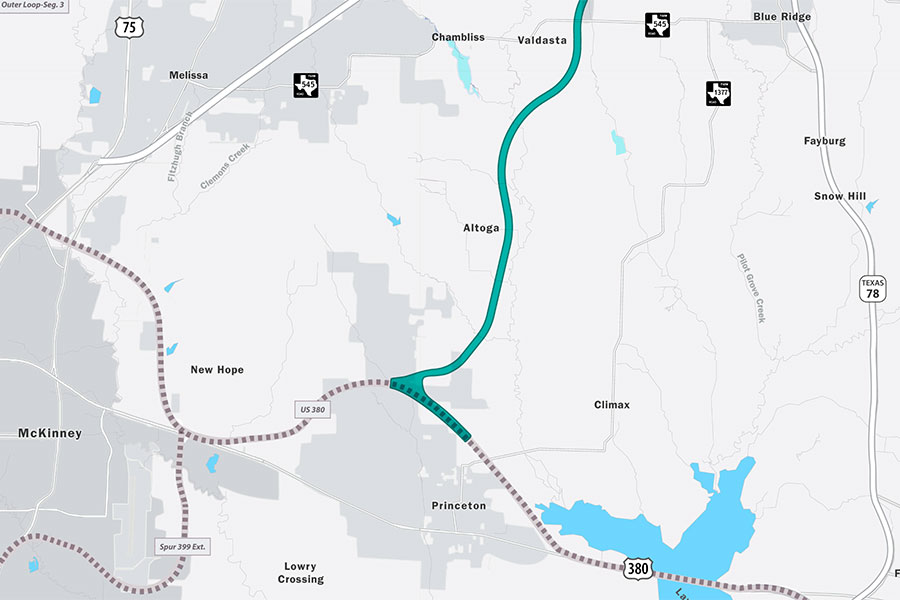
TxDOT has proposed a 10-mile north-south freeway through northeast Collin County. The department said the proposed corridor, presented in a Thursday, Aug. 6, public hearing in Princeton, “best satisfies the study goals while minimizing impacts to surrounding communities and environmental resources.” TGraphic Courtesy TxDOT
he Texas Department of Transportation has identified a recommended corridor for a proposed north-south freeway through northeast Collin County, advancing plans for a six-lane, controlled-access roadway connecting State Highway 121 with the future U.S. 380 Princeton Freeway.
TxDOT presented the recommended corridor during a public hearing attended by 99 people on Thursday, Aug. 6, at Clark Middle School in Princeton.
The Collin County Northeast Freeway would be built primarily on a new location and is intended to improve regional mobility and connectivity, reduce congestion and provide additional roadway capacity as the area develops.
TxDOT said the corridor also would improve safety and accessibility by providing links to major roadways. Traffic modeling estimates demand for the corridor could reach about 95,000 vehicles per day by 2070.
The approximately 10-mile study area extends from SH 121 near the Collin County Outer Loop south to the future U.S. 380 freeway near Princeton. The recommended corridor would connect with SH 121 at FM 2862, which TxDOT has identified as its preferred interchange location.
From there, the corridor would extend south through the area east of Valdasta and Altoga. TxDOT said the alignment was shifted east of Altoga and refined near Sister Grove Creek.
At its southern end, the preferred interchange option would connect the freeway directly with FM 75 at the future U.S. 380 Princeton Freeway. A secondary interchange option would connect with future Princeton Parkway and Dowlen Parkway.
The freeway is envisioned with six main lanes and two one-way frontage roads. Grade-separated interchanges would serve major arterial roads, with entrance and exit ramps connecting the freeway to frontage roads and the local street network.
The recommended corridor is not a final roadway design. TxDOT said the project remains in the “identify” phase, during which a feasible transportation corridor is being established and preserved.
The agency will continue refining the corridor through additional engineering, environmental analysis and coordination with other agencies.
TxDOT said schematic design work will further determine interchange locations, ramp configurations, drainage improvements, right-of-way requirements, multimodal accommodations and preliminary construction costs.
After the corridor study, the project would proceed through preliminary engineering and environmental review, followed by final design, right-of-way acquisition, utility coordination and, ultimately, construction. TxDOT said those phases would take several years.
Another public meeting is anticipated next year to present preliminary design and environmental studies. The current public comment period runs through Sept. 8, and TxDOT said comments will be addressed in a public meeting summary report.
Comments may be submitted.
Stay informed, and support your local community newspaper, subscribe to The Princeton Herald









0 Comments