


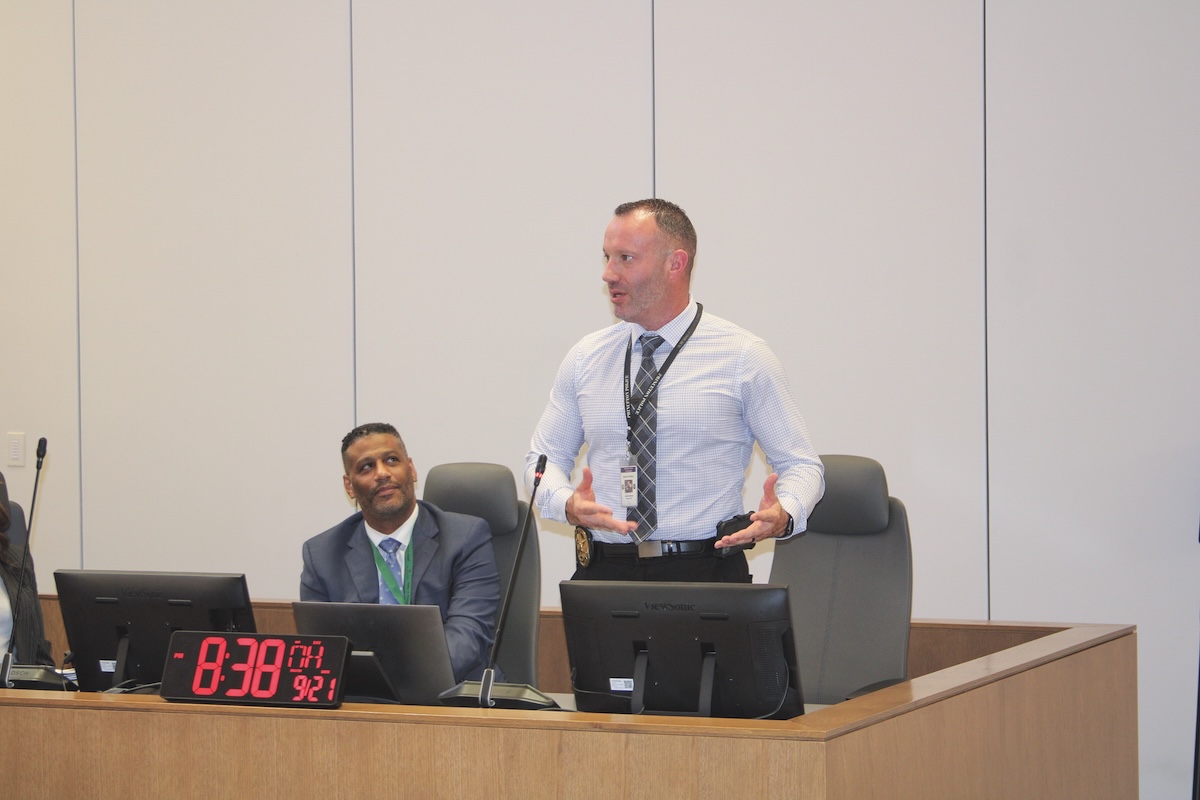
PISD Trustees Starla Sharpe and Cyndi Darland discuss issues in the upcoming school board election with challenger Chalotte Wilson in a forum Saturday, Sept. 26, at the PISD Administration Office. Bob Wieland/Princeton Herald
Candidates in the Nov. 3 general election for the Princeton ISD Board of Trustees and Princeton City Council addressed school vouchers, student preparation, government transparency and water and wastewater issues during a candidate forum conducted by the League of Women Voters of Collin County.
The Saturday, Sept. 26 forum, hosted by the Princeton-Lowry Crossing Chamber of Commerce and sponsored by Community Waste Disposal, featured two panels answering questions provided by the community. Moderator Aaron Rodriguez gave candidates one minute to respond to most questions. The forum was live-streamed and may be viewed at: https://bit.ly/4hvAm2X.
Three of four candidates seeking two at-large Princeton ISD trustee seats participated: incumbents Cyndi Darland and Starla Sharpe and challenger Charlotte Wilson. Candidate Ricky Gillespie did not attend.
Wilson, Darland and Sharpe all expressed opposition to Texas’ school voucher program, although they differed on its potential effect on Princeton ISD.
“The school voucher program was a bad idea,” Darland said. She predicted its impact on district enrollment and funding would be limited but said the district must continue advocating for special needs students.
Sharpe said vouchers take resources away from public schools and said Princeton ISD has a responsibility to help meet the needs of special education students.
“If we’ve got vouchers that are being taken away from our kids, that’s stuff that’s being taken away from our public schools,” Sharpe said. “I’m not for the vouchers.”
Wilson also opposed vouchers, arguing that public schools are required to serve all students and that shifting state money toward private education creates an additional burden for public districts.
“A public school board trustee … should never support something that takes away from its student population,” Wilson said.
Asked how PISD could better prepare students for college, careers or trades, Sharpe pointed to existing dual-credit and career and technical education programs, including cosmetology, HVAC and automotive repair. She said the district should continue expanding programs in response to student and workforce needs.
Darland said preparation begins with ensuring students can read at grade level. She also praised dual credit, technology courses and the district’s ROTC program as avenues for students preparing for life after high school.
Wilson said simply offering programs is not enough and questioned whether qualified students can actually gain access to them. She said 35 of 645 graduating students last year earned associate degrees and said the district should examine capacity, waiting lists and the academic pipeline that prepares younger students for advanced coursework.
The candidates also identified academic achievement and special education as major district needs.
Wilson called special education the district’s greatest need and said stronger curriculum, instructional materials, trained teachers and sufficient classroom time are necessary to improve student outcomes.
Darland emphasized reading proficiency and classroom discipline.
“They can’t learn if they can’t read,” Darland said.
Sharpe also highlighted special education, growth and academic performance.
“Compliance is the minimum. Serving our kids effectively is our goal,” Sharpe said, adding that parents should not have to become experts in education law to obtain services already identified for their children.
The candidates also addressed the district’s rapid enrollment growth and resulting rezoning. Sharpe called rezoning uncomfortable but necessary and said decisions should be based on enrollment data. Darland described it as a “necessary evil” preferable to overcrowded classrooms. Wilson said rezoning can be particularly difficult for elementary students when it sends them farther from their neighborhoods and increases transportation costs.
The second panel featured Ken Seligman and Sumbel “Susan” Zeb, candidates for Princeton City Council Place 6.
Place 7 candidate DeShawyna Walker, who is running unopposed, attended the forum but did not participate.
Transparency emerged repeatedly as an issue, particularly when the candidates were asked about city finances and water and wastewater billing.
Zeb said residents should receive an update on pending water and wastewater refunds and should have easier access to information about their daily usage and billing.
“I think it’s important for everyone to get an update on what that’s actually going to look like and when that’s going to implement it,” Zeb said.
Seligman also called for an explanation of the refunds and said utility finances should be open to public scrutiny.
“Everything we do in the city should be transparent to residents, including the way that we’re billed and way that money is managed,” Seligman said.
Asked more broadly about transparency in the city’s budget and finances, Zeb said she would push for an independent third-party audit and make the resulting information available to residents. She also suggested town halls as a way to explain city finances.
“When we’re talking about transparency as it relates to government, what we really mean is that information should be accessible,” Zeb said. “Residents shouldn’t have to dig around for it.”
Seligman said residents should be involved much earlier in development of the city budget, beginning when staff starts assembling proposals rather than after most of the work has been completed. He advocated multiple town halls and maintaining an online check register showing how city money is spent.
The candidates also addressed capital spending and debt. Seligman said Princeton should complete projects to which it has already committed before beginning new ones and said the city needs to give greater attention to its library.
Zeb said capital projects should be evaluated by whether they are needed, on budget and on schedule and by their long-term cost to taxpayers. She called for greater public access to information tracking projects from authorization through completion.
On economic development, Seligman said Princeton has become heavily weighted toward residential development and needs more commercial growth to provide jobs, shopping opportunities and a broader tax base.
Zeb agreed that additional commercial development is needed but said businesses typically follow population growth. She called for more aggressive business recruitment while determining what types of businesses residents want. She also said she does not support a data center as an economic development project despite its potential revenue.
The two candidates offered different approaches to the relationship between the council and city manager. Zeb emphasized trust and communication and said Princeton’s permanent city manager should understand the respective roles and be able to work collaboratively with council members. Seligman said council members are responsible for directing the city manager and argued the council should take a stronger role in setting the city’s direction.
Both said greater resident involvement in local government is needed. Seligman emphasized community activism and volunteerism, while Zeb suggested taking city government to residents through homeowners associations and community events rather than expecting busy residents to attend government meetings.
Asked to name a favorite thing about Princeton, Seligman cited the opportunity to be part of a small but rapidly growing community.
Zeb chose something simpler.
“I like the greenery,” she said.
Early voting for the Tuesday, Nov. 3, election begins Monday, Oct. 19, and runs daily through Friday, Oct. 30.
Stay informed, and support your local community newspaper, subscribe to The Princeton Herald.











0 Comments