

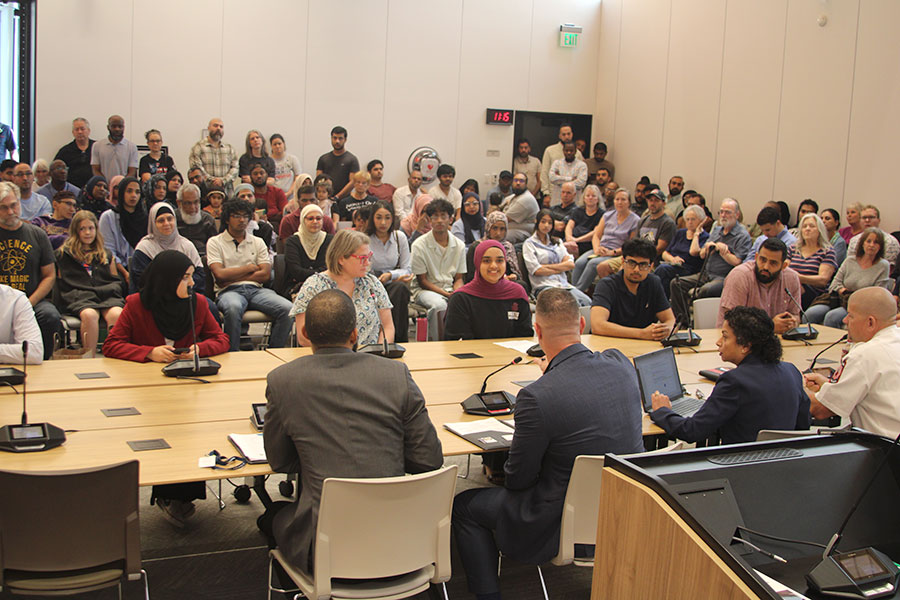
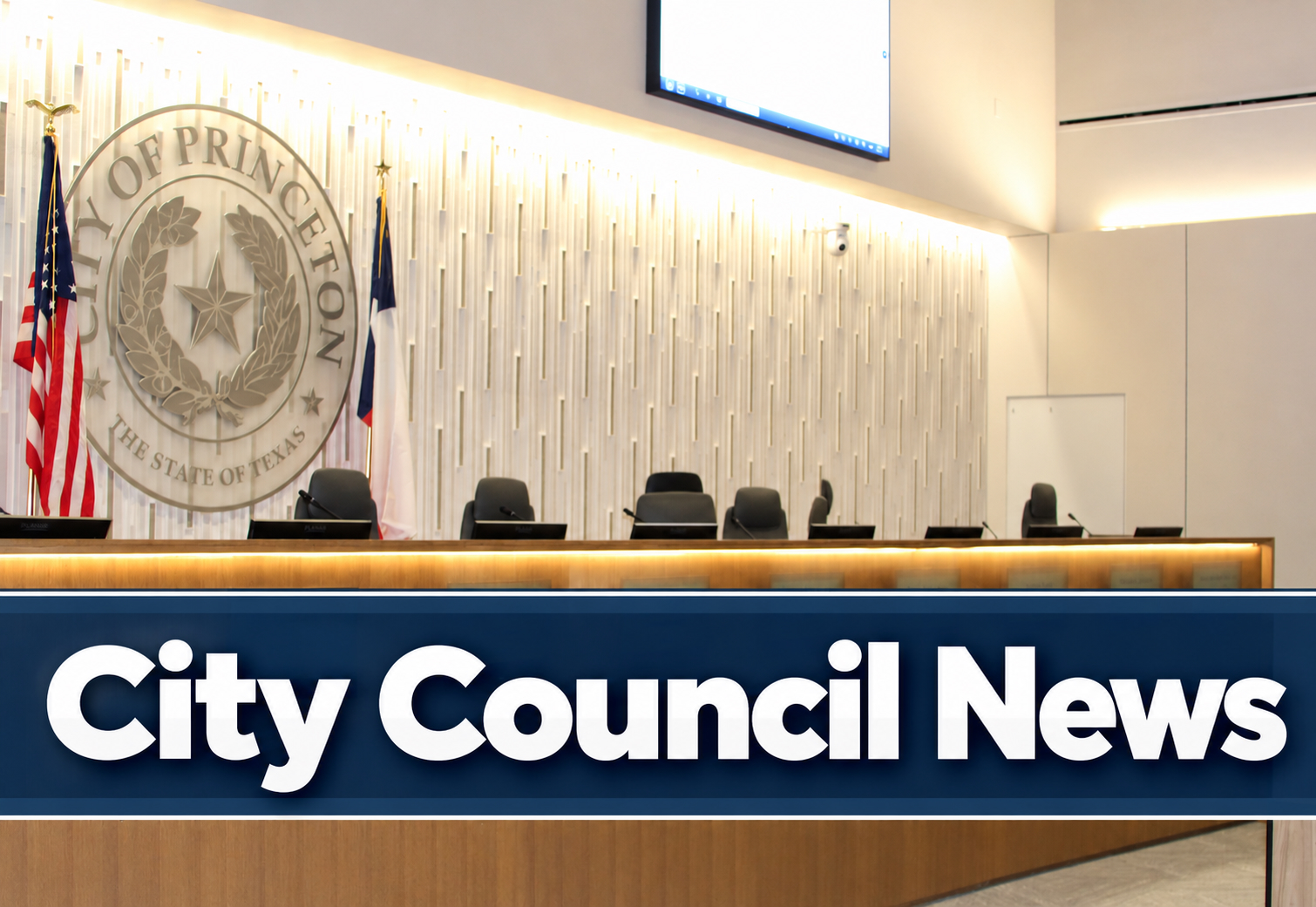
The Princeton City Council Chamber is packed for a town hall on Saturday, June 6, conducted by Mayor Eugene Escobar Jr., center-left, and Police Chief James Waters, the interim city manager, center-right. Bob Wieland/The Princeton Herald
A town hall meeting overflowed the Princeton City Council chamber as speakers expressed strong opinions on subjects including AI data centers and the proposed construction of a mosque south of the city.
Mayor Eugene Escobar Jr. called the meeting for 11 a.m. Saturday, June 6, but it ran an hour past its scheduled stop time.
Escobar was seated at a long row of tables with Police Chief James Waters, who is also acting as the city’s interim city manager, city staff and board members, and Councilmembers Terrance Johnson and Carolyn David-Graves.
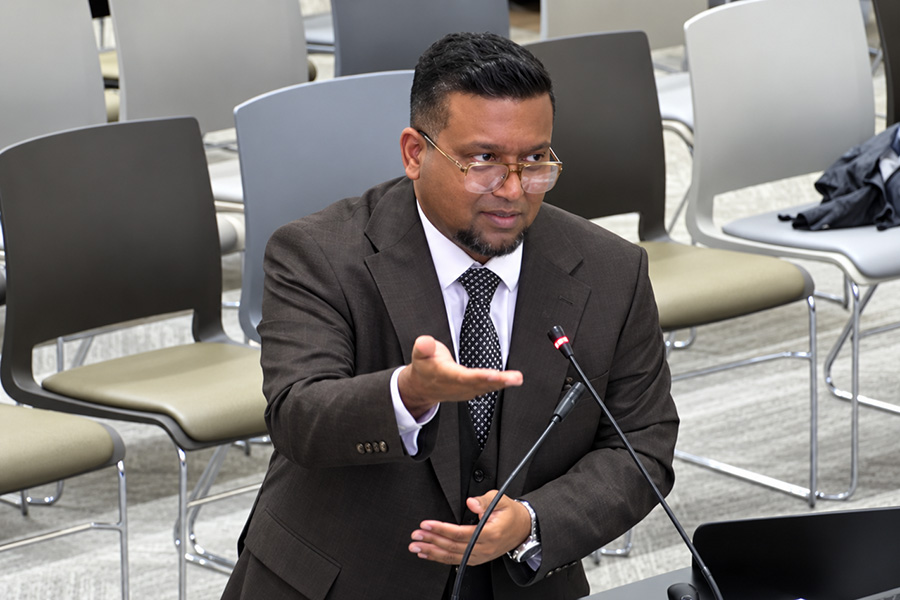
Speakers lined up for turns to sit at microphones placed around the table while members of the audience applauded remarks.
The city officials got little opportunity to answer questions since most speakers just wanted to state their position, speaking extemporaneously or reading from notes on their phones.
Although no data centers are planned for the immediate Princeton area, Escobar said, speakers decried the spread of data centers in Texas, saying they would consume electricity powering the computers and waste valuable water resources used to cool the servers.
Much of the time was taken up discussing social media reports that the Princeton Islamic Center, which operates a mosque on Fourth Street, planned a new building south of the city limits on undeveloped County Road 456.
“Even though the property is within the city’s ETJ [extra-territorial jurisdiction], it does not need to be platted (per state law) because it is 5 acres in size,” the mayor said. “Any permits, inspections or approvals are handled by the county.”
While some speakers expressed concerns whether infrastructure could support the mosque, other speakers questioned Islamic theology and quoted what they said were excerpts from the Quran regarding non-believers, referred to as infidels.
Some Muslim residents said they had lived in the city for years, wanted to be good neighbors and cautioned against cherry-picking quotes from the Quran.
The Princeton Islamic Center estimated the city had about 1,200 Muslim residents.
One concern expressed fear that Muslims would institute sharia law in Texas. Escobar said the U.S. Constitution and local laws and ordinances always take precedence. A Muslim resident said sharia was a moral code similar to the moral codes within other religions and does not apply to non-Muslims.
After the meeting, Johnson praised the turnout and community concern. But he said too much time was taken discussing data centers and the proposed mosque.
“What was discussed and confirmed today is that none of these things are happening in Princeton,” Johnson said. But even when that was debunked and discussed, it didn’t stop the conversations. I think it started to go more into a theology debate, and I felt like the city provided a platform from that, opposed to going out there and handling the people’s business and getting that information out.”
He added that future meetings would build upon lessons learned from the meeting.
“I think today’s town hall will give us an opportunity to fine tune some things going forward,” Johnson said.
A video of the town hall is available at: princetontx.gov/721/Office-of-the-Mayor.
Stay informed, and support your local community newspaper, subscribe to The Princeton Herald












0 Comments