

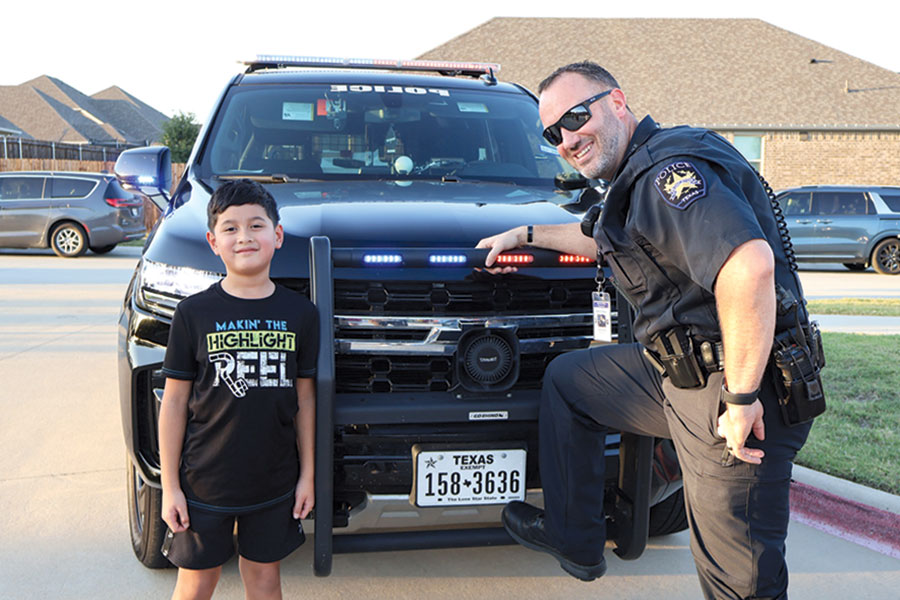
Police Chief James Waters hopes to meet Princeton youth at National Night Out again this year. File Photo
National Night Out (NNO) has become a familiar part of the calendar for communities across the United States, with most of the U.S. observing it the second Tuesday in August.
But because of stifling summer temperatures, Princeton and other Texas cities moved the event to the second Tuesday in October and this year’s Night Out will be held Oct. 7.
The program was created in 1984 by the nonprofit National Association of Town Watch to promote neighborhood spirit and improve relationships between residents and local law enforcement.
The idea was an instant hit and the inaugural event drew about 2.5 million people in 400 communities spread across 23 states, NNO said.
It has since grown into a nationwide observance involving millions of people, thousands of police departments and countless community organizations.
Participation ranges from block parties and cookouts, parades, safety fairs and visits by police, fire and local officials.
The Princeton Police Department has at least 10 locations officers will visit between 5:30 p.m. and 8:30 p.m., Chief James Waters said.
Police will be at the Trails of Riverston, 1011 Platinum Drive; Eastridge, 5201 Golden Trout; Arcadia Farms, 300 S. Beauchamp Boulevard; Princeton Lakes, 214 Island Way; San Remo, 461 San Remo Drive; the Swig store, 1530 W. Princeton Drive, Suite 101; Villas of Monte Carlo, 1301 Riviera Drive; Lake Meadow, 840 Breakwater Drive; De Berry Estates, 1601 Mercer Lane and Windmore Residential, 903 Airbender Drive.
“National Night Out enhances the relationship between neighbors and law enforcement while bringing back a true sense of community,” NNO said on its website. “Furthermore, it provides a great opportunity to bring police and neighbors together under positive circumstances.”
NNO said the idea behind the program is rooted in the concept of “lights on, neighbors out,” where residents leave porch lights burning as a symbolic sign of vigilance while taking time to engage with each other in public.
Advocates said the program encourages residents to look out for one another and to treat officers as partners in safety, not distant authorities.
For law enforcement agencies, the events provide an opportunity to humanize their work, answer questions directly and listen to concerns that might otherwise go unheard.
Participation has varied year to year, but organizers said it typically draws more than 15 million people from more than 16,000 communities in all 50 states, U.S. territories and military bases.
To support local journalism subscribe to your community newspaper The Princeton Herald today!
By Bob Wieland | [email protected]










0 Comments