

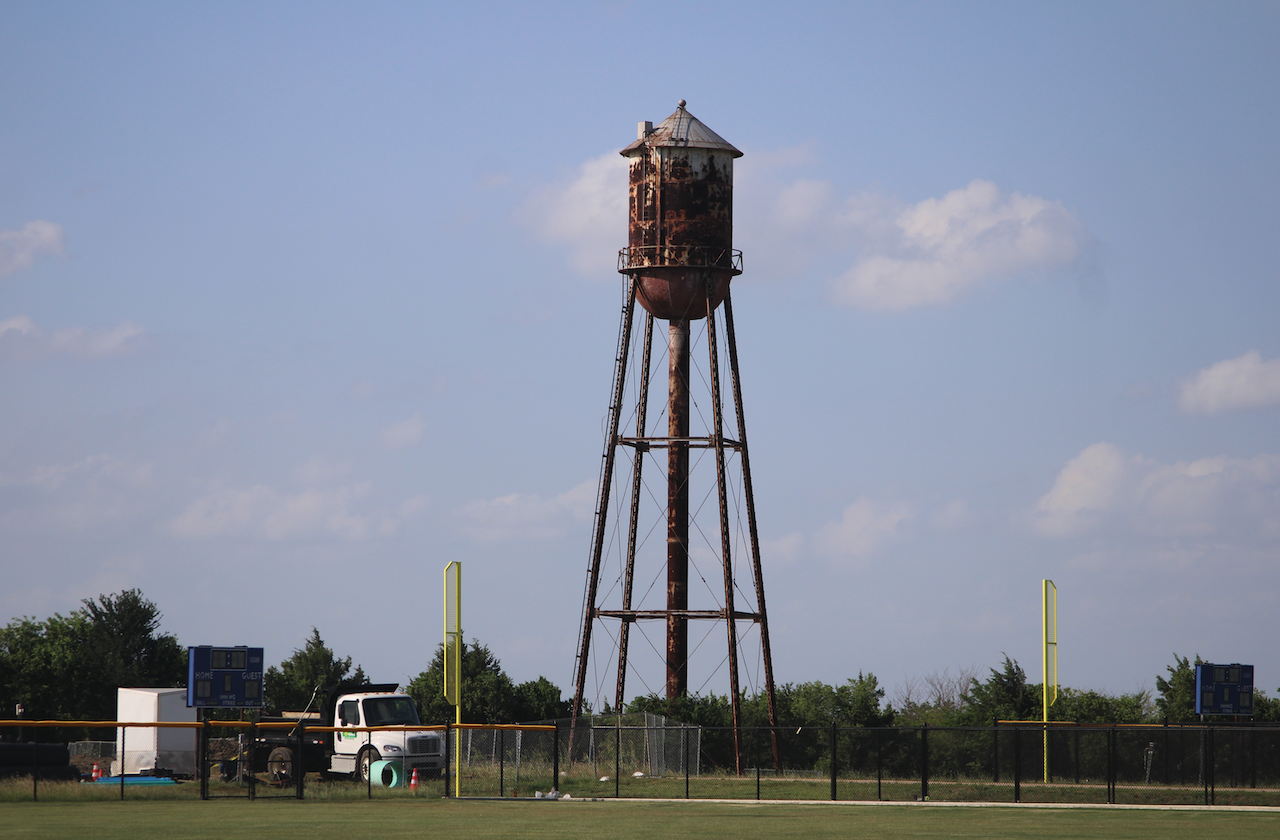
A water tank built in 1940 is the largest remnant of a migrant labor camp that later housed German POWs during WWII. Photo Bob Wieland/The Princeton Herald
Princeton City Council members would like to preserve historic sites and artifacts in the city but are unsure whether to designate a board for the task.
After hearing from residents concerned about the lack of preservation efforts, Councilmember Terrance Johnson asked for council to consider plans to identify and preserve links to the city’s past.
Brothers T.B and George Wilson began farming the rich Blackland Prairie in the late 1870s and the area became known as Wilson’s Switch after the Missouri-Kansas-Texas Railroad extended its line from McKinney to Greenville in 1871.
A post office was established in 1888 under the name Princeton, in honor of landowner Prince Dowlin, since there was already a post office named Wilson.
Princeton was incorporated in 1912, and a migrant camp was built in 1940 to house the hundreds of laborers who worked seasonally in the cotton and onion fields. A 30,000-gallon water tower built at that time is the most visible remnant of that era.
During 1945, the facility briefly became a prisoner of war camp for German soldiers captured during World War II.
Longtime Princeton residents still refer to the site, now in J.M. Caldwell Sr. Community Park, as the POW camp and it was a focal point in a report by Parks & Recreation Director Chase Bryant.
“This site represents the most significant historic artifact location in the city and reflects Princeton’s role in national wartime efforts,” Bryant said at a Monday, April 27, council work session.
Other remnants of the past in the city are several early brick and wood-frame buildings along with the Princeton Cemetery on Yorkshire Drive, Bryant said.
He said the city could form an advisory preservation board to document all the assets throughout the city, develop policies and build community awareness.
“Just identifying those key components seems to be the focus at this point,” he said.
Bryant added the panel could transition in time to a formal historic preservation committee with limited regulatory tools.
Two issues, Bryant said, would be the amount of city involvement and the impact on the municipal budget.
Johnson said another problem could be that buildings or areas that are not currently deemed historical could become so in 10 to 15 years.
“I just want to make sure that we’re not losing some of those things that people that live here will consider would be considered historic,” he said.
Councilmember Cristina Todd said she supported the idea of a committee and said items like the original plans for the POW camp could be displayed in the Deffibaugh Community Center while the city worked with organizations to seek preservation grants or other funding.
“There are a lot of things that we can do once this door gets open, but it’s a door that has actively been kept shut,” Todd said.
Councilmember Carolyn David-Graves agreed, saying, “I think it’s important overall to preserve or history … Princeton is a place that we can be proud of and it is a place that we call home.”
According to Councilmember Steve Deffibaugh, the Collin County Historical Society could help pinpoint some of the places worth preserving.
“We got a lot of history in this community that a lot of people don’t know about,” he said. “A lot of people that haven’t lived here but five or six years don’t really know what’s going on here.”
Bryant said he would return to council with suggestions such as a hybrid model to review sites and processes with limited regulatory tools.
Stay informed and support local journalism — subscribe to The Princeton Herald.











0 Comments